Motivation
Semantic segmentation assigns a class label to every pixel in an RGB image, producing a label map at input resolution. BiSeNet decouples two competing demands — spatial detail preservation and large receptive field — into two parallel branches that run concurrently and are merged by a learned fusion module. V1 (ECCV 2018) addresses the failure modes of three common speed-up strategies (input downsizing, channel pruning, and stage dropping), all of which sacrifice either detail or context; V2 (IJCV 2021) redesigns every component of V1 using purpose-built lightweight blocks and eliminates the dependency on an ImageNet-pretrained backbone. Both versions target real-time inference (≥30 FPS on a single GPU) with competitive accuracy on urban scene benchmarks.
Architecture
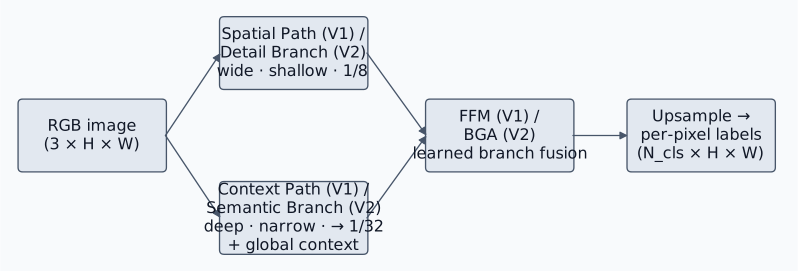
Family & shape. CNN. Two-branch (bilateral) encoder with a learned branch-fusion module and a lightweight upsampling head. Input → per-pixel logits . In V1, both branches produce feature maps at of the input resolution. In V2, the Detail Branch outputs at and the Semantic Branch reaches before fusion. V1 uses ImageNet-pretrained backbones for the context-providing branch (Xception39, ResNet18, or ResNet101); V2 is trained entirely from scratch with no ImageNet backbone. This is a two-paper family page: V1 (2018) introduces Spatial Path + Context Path + ARM + FFM; V2 (2021) replaces every component with Detail Branch + Semantic Branch + BGA + Booster.
Blocks. Both eras are described below.
V1 components. The Spatial Path consists of three consecutive Conv→BN→ReLU layers each with stride 2, yielding output at the input resolution; the large spatial extent of this path preserves fine-grained detail. The Context Path uses a lightweight backbone (Xception39 in the primary speed variant; ResNet18 or ResNet101 in accuracy variants) followed by global average pooling to guarantee receptive field equal to the full image; an incomplete U-shape fuses features from the last two backbone stages at resolution. An Attention Refinement Module (ARM) is applied at each Context Path stage output: global average pooling → 1×1 conv → BN → sigmoid → channel-wise multiply. The Feature Fusion Module (FFM) merges the two paths: concatenate Spatial Path and Context Path outputs → BN → global average pooling → 1×1 conv → ReLU → 1×1 conv → sigmoid → channel reweight → residual addition (SE-style channel attention).
V2 components. The Detail Branch is wide and shallow, with no residual connections, following VGG-style conv stacking. Three stages (S1/S2/S3) each begin with a stride-2 convolution; channel widths are 64 / 64 / 128, and total downsampling is . The Semantic Branch is deep and narrow; its channel capacity is a fraction of the Detail Branch (chosen by ablation, Table 3a). It uses a Stem Block at S1 (two parallel downsampling paths — one 3×3 conv stride-2, one max-pool — concatenated) for fast early downsampling. Stages S3–S5 use Gather-and-Expansion (GE) layers: a 3×3 conv to gather and expand channels, a 3×3 depthwise conv over the expanded representation, and a 1×1 projection back to output width, with expansion ratio (Table 3c). When stride = 2, two stacked depthwise convolutions form the main path and a 3×3 separable conv acts as the shortcut. The final S5 stage includes a Context Embedding (CE) block: global average pooling broadcast-added back to the spatial feature map as a residual, embedding scene-level context at negligible cost. The Semantic Branch outputs at .
The Bilateral Guided Aggregation (BGA) layer merges the two V2 branches via bidirectional gating. The BGA fusion in PyTorch:
import torch
import torch.nn as nn
import torch.nn.functional as F


class BilateralGuidedAggregation(nn.Module):
    """Each branch modulates the other, then the two are summed."""

    def __init__(self, channels: int) -> None:
        super().__init__()
        self.detail_dw = nn.Conv2d(channels, channels, 3, padding=1, groups=channels, bias=False)
        self.detail_pw = nn.Conv2d(channels, channels, 1, bias=False)
        self.sem_dw = nn.Conv2d(channels, channels, 3, padding=1, groups=channels, bias=False)
        self.sem_pw = nn.Conv2d(channels, channels, 1, bias=False)
        self.bn_sem = nn.BatchNorm2d(channels)

    def forward(self, detail: torch.Tensor, semantic: torch.Tensor) -> torch.Tensor:
        size = detail.shape[2:]
        # Semantic guides detail: sigmoid-gated, upsampled to detail resolution.
        sem_gate = torch.sigmoid(F.interpolate(
            self.bn_sem(self.sem_pw(self.sem_dw(semantic))), size=size,
            mode="bilinear", align_corners=False))
        detail_out = detail * sem_gate
        # Detail guides semantic: average-pooled down to semantic resolution.
        det_gate = F.adaptive_avg_pool2d(
            self.detail_pw(self.detail_dw(detail)), output_size=semantic.shape[2:])
        sem_out = semantic * det_gate
        return detail_out + F.interpolate(sem_out, size=size, mode="bilinear", align_corners=False)
The Booster attaches auxiliary segmentation heads to intermediate Semantic Branch stages during training only; all Booster heads are discarded at inference, adding zero inference cost.
Training. V1 pre-trains the Context Path backbone on ImageNet; the Spatial Path is trained from scratch. The principal loss is softmax cross-entropy applied to the FFM output, plus two auxiliary softmax losses on Context Path stage outputs, combined with equal weight :
Softmax cross-entropy on the final fused output plus auxiliary cross-entropy on each Context Path stage, weighted equally.
V1 optimizer: SGD, batch 16, momentum 0.9, weight decay , poly LR schedule with initial LR and power 0.9. Scale augmentation: . V1 headline metrics (Cityscapes test, 1536×768 inference on Titan XP): BiSeNet-Xception39 achieves 68.4% mIoU at 105.8 FPS (Table 6); BiSeNet-Res18 achieves 74.7% mIoU at 65.5 FPS (Table 6); BiSeNet-Res101 achieves 78.9% mIoU without an FPS constraint (Table 7).
V2 trains entirely from scratch (kaiming-normal initialisation, no ImageNet pretraining). Booster auxiliary heads add training-only supervision at intermediate Semantic Branch stages. Optimizer: SGD, batch 16, momentum 0.9, weight decay , poly LR schedule with initial LR and power 0.9, 150K iterations on Cityscapes. V2 headline metrics (Cityscapes test, GTX 1080 Ti, 2048×1024 effective input): BiSeNetV2 achieves 72.6% mIoU at 156 FPS (Table 7); BiSeNetV2-L (, ) achieves 75.3% mIoU at 47.3 FPS (Table 7). Cityscapes val ablation (Table 2): Detail + Semantic + BGA = 69.67% mIoU; adding Booster raises this to 73.19% mIoU.
Complexity. V1: BiSeNet-Xception39 = 5.8M parameters / 2.9 GFLOPs; BiSeNet-Res18 = 49.0M parameters / 10.8 GFLOPs (both at 640×360 input, Table 4). V2: 21.15 GFLOPs at (Table 3a).
Implementations
The official author release (TorchSeg) covers V1; community PyTorch implementations (CoinCheung/BiSeNet, mmsegmentation) cover both V1 and V2.
Assessment
Novelty.
- V1 decoupled spatial detail and receptive field into two parallel paths rather than recovering spatial information through decoder skip connections applied to costly high-resolution feature maps (the U-shape encoder-decoder approach); ARM and FFM introduce SE-style channel attention for context refinement and branch fusion respectively.
- V2 replaced the ImageNet-pretrained Context Path backbone with a from-scratch Semantic Branch built from the Gather-and-Expansion layer — an inverted-bottleneck variant with an added 3×3 gather convolution that provides higher feature expressiveness than a standard MobileNetV2 bottleneck — and introduced Bilateral Guided Aggregation, a bidirectional cross-branch gating mechanism stronger than summation or concatenation (Table 2: BGA +1.07 mIoU over concatenation on Cityscapes val).
- Both variants build on the FCN fully-convolutional dense-prediction paradigm (long2015-fcn), where both branches produce feature maps at fractional stride and feed a pixel-wise prediction head.
Strengths.
- Real-time frontier with table-cited speed-accuracy trade-offs: V2 achieves 72.6% mIoU at 156 FPS versus V1 Xception39 at 68.4% mIoU at 105.8 FPS, a gain in both dimensions simultaneously (Table 7, V2; Table 6, V1).
- The bilateral design makes the detail-providing path nearly free in wall-clock time, since both branches run concurrently.
- V2 removes the ImageNet-pretraining dependency entirely, enabling direct training on target-domain data without a pretrained backbone.
Limitations.
- The output stride of the Spatial Path (V1) and Detail Branch (V2) smears boundaries finer than 8 pixels and loses small or thin structures (poles, distant signage).
- A single global average pooling operation encodes scene-level context; this cannot represent multi-scale structured spatial context the way ASPP (DeepLab) or PSP pooling does.
- BN-heavy architectures — BN appears in both paths, in ARM, FFM, and BGA — are numerically unstable at batch size 1 without fused or synchronized BN, complicating single-image mobile deployment.
- V2 trained from scratch exhibits significant domain sensitivity: CamVid mIoU improves by more than 6 points when initializing from Cityscapes pre-training rather than training from scratch (V2, §5.3).
References
- C. Yu, J. Wang, C. Peng, C. Gao, G. Yu, S. Nong. BiSeNet: Bilateral Segmentation Network for Real-time Semantic Segmentation. ECCV, 2018. arXiv 1808.00897
- C. Yu, C. Gao, J. Wang, G. Yu, C. Shen, S. Nong. BiSeNet V2: Bilateral Network with Guided Aggregation for Real-time Semantic Segmentation. IJCV, 2021. arXiv 2004.02147
- J. Long, E. Shelhamer, T. Darrell. Fully Convolutional Networks for Semantic Segmentation. CVPR, 2015. arXiv 1411.4038
- K. He, X. Zhang, S. Ren, J. Sun. Deep Residual Learning for Image Recognition. CVPR, 2016. arXiv 1512.03385