Motivation
Detect the inner corners of a planar checkerboard pattern in a single forward pass, without requiring the number of squares as a prior. Input: grayscale image of arbitrary size. Output: a response map of identical spatial size carrying a per-pixel corner score. The model is specific to per-pixel fully-convolutional regression of corner likelihood followed by threshold + NMS + clustering post-processing, in contrast to pattern-aware algorithms that reason about the checkerboard's global grid structure (OCamCalib, ROCHADE) and to hand-crafted local corner responses (ChESS, Harris).
Architecture
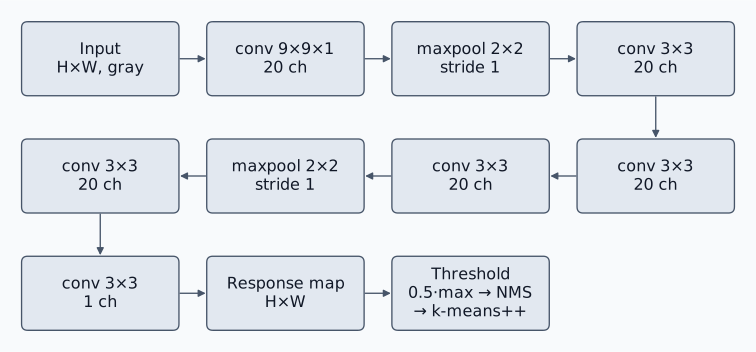
Family & shape. Fully-convolutional CNN. Input: grayscale image . Output: response map , same spatial size. Six convolutional layers, 20 channels each except the final single-channel head.
Blocks. Six convolutional layers with ReLU after each. Conv1 uses a kernel; conv2–conv6 use kernels. Max-pooling of size follows conv1 and conv4. The defining design choice is stride 1 on every convolution and max-pool with zero-padding, so the response map retains the input's spatial resolution (§2.1). Weights are initialised from ; biases constant . Parameter count: 16,301 (conv1 1,640 + conv2–5 each 3,620 + conv6 181).
Per-pixel cross-entropy normalised by the count of ground-truth positives and negatives to compensate for the positive-label fraction, with regularisation coefficient .
with the output clipped to on positives and on negatives (Eq. 5) so the log stays finite.
Inference appends three post-processing stages applied in order (§2.2): (i) drop pixels whose response is below , (ii) non-maximum suppression on -pixel bounding boxes with IoU threshold , (iii) -means++ with on the survivors, discarding clusters containing fewer than two points.
Training. Dataset: 8,900 grayscale VGA (640 × 480) images captured with 7×7 / 6×9 / 7×11 / 9×9 / 12×13 inner-corner checkerboards and synthetically augmented with rotations, intensity inversion, Gaussian noise, and radial + tangential distortion (§3). Split: 8,000 train / 900 validation. Objective: the weighted cross-entropy + loss above. Optimiser: SGD with momentum , batch size 20, initial learning rate on a staircase exponential schedule (Eq. 6). Reported benchmarks on ROCHADE's external sets: mean corner-location error 0.812 px / missed rate 1.169 % on uEye (Table 1), 0.576 px / 0.907 % on GoPro (Table 2); zero double detections on both and zero false positives on GoPro.
Complexity. 16,301 trainable parameters on a 640 × 480 input — the 2,939 parameters of the MATE antecedent. FLOPs and inference memory not reported by the paper.
Implementations
One public TensorFlow implementation. The repository carries no LICENSE file, which defaults to all-rights-reserved — see Limitations.
Assessment
Novelty.
- Extends MATE's three-convolution corner network to six convolutions, producing a per-pixel response map that preserves input resolution via stride-1 max-pools, contrasting with MATE's subsampled-grid output.
- Replaces MATE's mean-squared-error objective with a positive-negative-normalised cross-entropy to handle the label imbalance (§2.1).
- Swaps MATE's fixed decision threshold for an adaptive per-image maximum, composed with 4×4 NMS and -means++ cluster pruning as a three-stage false-positive filter (§2.2).
Strengths.
- Accepts arbitrary input size and does not require the checkerboard's square count as a prior — unlike OCamCalib and ROCHADE which consume pattern dimensions (§4).
- On the ROCHADE uEye set reduces mean corner-location error from 1.009 px (MATE) and 0.946 px (ChESS) to 0.812 px, and cuts the false-positive count from 492 (MATE) to 93 (Table 1).
- On the ROCHADE GoPro set achieves 0 double detections and 0 false positives under strong lens distortion, with 0.576 px mean accuracy against MATE's 0.835 px (Table 2).
Limitations.
- The 5-pixel acceptance radius used in the accuracy metric (§4) sets the precision floor; sub-pixel refinement is not part of the model and must be bolted on from a separate saddle-point or gradient method.
- OCamCalib reaches 0.319 px / 0 % missed on the same uEye set by exploiting known pattern dimensions; CCDN trades that precision for pattern-agnosticism (Table 1).
- The only public TensorFlow implementation is unlicensed, unmaintained since 2018, ships no trained weights, and has no documented provenance from the paper's authors — downstream use requires retraining from scratch and resolving the licensing question.
- The cluster-size floor and the fixed in k-means++ are hand-tuned; sparse partial checkerboards with only a few visible corners at the image border risk being pruned as outliers.
Remarks
- Compared with MATE: see When to choose MATE over CCDN on the MATE page, which hosts the comparison per the older-paper-hosts rule. CCDN doubles MATE's depth (six vs three convolutions), replaces MSE with positive-negative-balanced cross-entropy, enforces stride-1 max-pools to preserve input resolution, and adds adaptive-threshold + NMS + k-means++ post-processing.
- Compared with CCS: see When to choose CCS over CCDN on the CCS page, which hosts the comparison per the older-paper-hosts rule (CCS 2022 < CCDN 2023). CCS embeds a UNet detector with sub-pixel Gaussian surface fitting inside a calibration pipeline that also performs CNN distortion correction and image-level RANSAC; CCDN remains a standalone pattern-agnostic detector with explicit threshold + NMS + k-means++ post-processing.
References
- B. Chen, C. Xiong, Q. Zhang. CCDN: Checkerboard Corner Detection Network for Robust Camera Calibration. arXiv 2302.05097, 2023. arXiv
- S. Donné, J. De Vylder, B. Goossens, W. Philips. MATE: Machine Learning for Adaptive Calibration Template Detection. Sensors 16(11):1858, 2016. MDPI
- S. Bennett, J. Lasenby. ChESS — Quick and Robust Detection of Chess-board Features. Computer Vision and Image Understanding 118:197–210, 2014. arXiv
- S. Placht, P. Fürsattel, E. Mengue, H. Hofmann, C. Schaller, M. Balda, E. Angelopoulou. ROCHADE: Robust Checkerboard Advanced Detection for Camera Calibration. ECCV 2014, 766–779.
- M. Rufli, D. Scaramuzza, R. Siegwart. Automatic Detection of Checkerboards on Blurred and Distorted Images. IROS 2008, 3121–3126.
- Y. Zhang, X. Zhao, D. Qian. Learning-Based Distortion Correction and Feature Detection for High Precision and Robust Camera Calibration. IEEE Robotics and Automation Letters 7(4):10470–10477, 2022. arXiv